Drawback parsing package deal android. Think about this: you are wanting to check out a shiny new app, obtain the APK, faucet set up, and…nothing. As a substitute, a cryptic error message flashes, leaving you bewildered. This digital hiccup, the “downside parsing package deal Android,” is a typical foe within the Android world, a roadblock between you and the newest apps. It is like a secret code the telephone cannot decipher, a irritating puzzle that stops the app from taking its rightful place in your system.
Let’s delve into this situation, untangling the knots to know its origins and, extra importantly, how you can conquer it.
The core of this downside lies within the lack of ability of your Android system to know the APK file. “Parsing” is the method of the system studying and deciphering the APK’s construction, like studying a blueprint earlier than constructing a home. When this course of fails, it is typically because of quite a lot of components: corrupted recordsdata, model incompatibilities, signature mismatches, and even storage woes.
Consider it as a collection of checks and balances that should align completely for a profitable set up. Understanding these components is essential to unlocking the answer, permitting you to bypass the errors and set up your required purposes.
Understanding “Drawback Parsing Bundle Android”
Embarking on the journey of Android app improvement typically leads builders down a path the place they encounter a peculiar error: “Drawback Parsing Bundle.” This cryptic message can deliver your artistic endeavors to a screeching halt, leaving you scratching your head. Let’s demystify this frequent Android hurdle and perceive its intricacies.
Basic Idea of “Drawback Parsing Bundle Android”
The “Drawback Parsing Bundle” error on Android is basically a well mannered manner of claiming, “Hey, I could not perceive what you are making an attempt to put in.” It signifies that the Android system is unable to accurately interpret the applying package deal file (APK). The APK is the file format Android makes use of to distribute and set up purposes, containing all the required code, sources, and metadata.
When the system encounters an issue parsing this file, it is unable to proceed with the set up, and this error message seems.
Definition of “Parsing” and Its Significance
Parsing, within the context of Android, is the method of analyzing and deciphering the APK file’s contents. It is just like the Android system’s manner of studying and understanding the blueprint of your utility. The system examines the APK to make sure it is legitimate, suitable with the system, and does not comprise any malicious code.Parsing is essential as a result of:
- It verifies the APK’s integrity, defending customers from probably dangerous purposes.
- It checks for compatibility, guaranteeing the app is designed for the system’s {hardware} and software program.
- It extracts important info just like the app’s title, model, and required permissions.
With out profitable parsing, the Android system can’t set up the applying, highlighting the significance of this preliminary stage.
Frequent Situations The place the Concern Arises
The “Drawback Parsing Bundle” error can pop up in varied conditions, every with its personal set of potential culprits.
- APK Corruption: A corrupted APK file is a typical offender. This will occur throughout the obtain course of, file switch, and even throughout the construct course of if there are points along with your improvement surroundings.
- Incompatible APK: The APK may be incompatible with the system’s Android model, structure (e.g., ARM, x86), or display screen decision. An app constructed for a more recent Android model won’t run on an older system.
- Signature Points: Android requires all APKs to be digitally signed. If the signature is invalid, lacking, or mismatched, the parsing course of will fail. This will occur if the signing secret is misplaced or if there are issues with the construct course of.
- Bundle Identify Conflicts: If an app with the identical package deal title is already put in on the system (presumably from a unique supply), the set up may fail. Bundle names should be distinctive throughout all apps on a tool.
- Storage Points: Inadequate cupboard space on the system can forestall the set up of the app, triggering the parsing error.
- Safety Restrictions: The system’s safety settings may block the set up of apps from unknown sources, which might result in parsing errors. This can be a frequent setting designed to guard customers from putting in probably dangerous apps from untrusted sources.
- Malformed APK: Errors within the APK file construction, akin to lacking recordsdata or incorrect manifest entries, could cause parsing failures. This typically signifies an issue with the app’s construct course of or the developer’s code.
As an illustration, contemplate a state of affairs the place a consumer downloads an APK from an unofficial web site. The obtain is interrupted, leading to a corrupted file. When the consumer makes an attempt to put in it, the “Drawback Parsing Bundle” error will possible seem as a result of the Android system can’t perceive the unfinished APK.
Causes of “Drawback Parsing Bundle”
Ah, the dreaded “Drawback Parsing Bundle” error! It is the digital equal of a cranky toddler refusing their greens – irritating and infrequently tough to resolve. However worry not, as a result of understanding the basis causes is step one towards a smoother Android expertise. This error can stem from varied sources, starting from corrupted recordsdata to system limitations. Let’s dive into the frequent culprits.
Corrupted APK Information
A corrupted APK file is sort of a cake that is been dropped on the ground – nobody needs to the touch it. When an APK (Android Bundle Equipment) file turns into broken throughout obtain, switch, or storage, the system struggles to know its contents. This corruption can occur for a lot of causes.The next eventualities are frequent causes:
- Incomplete Downloads: If the obtain course of is interrupted (because of a poor web connection, for instance), the APK file won’t be totally transferred to your system. This incomplete file is, after all, unusable.
- Switch Errors: Copying an APK from a pc to your telephone through USB cable could be liable to errors, particularly if the connection is unstable or the switch is interrupted.
- Storage Points: Unhealthy sectors in your system’s storage (like a defective arduous drive) can result in information corruption, together with inside APK recordsdata.
Incompatibility Points with Completely different Android Variations
Android, very like a very good wine, has advanced over time. New variations introduce new options, APIs, and system necessities. Typically, older apps merely aren’t suitable with newer variations of Android, and vice-versa. That is like making an attempt to suit a sq. peg right into a spherical gap; it simply will not work.Think about these features:
- API Stage Variations: Apps are sometimes constructed concentrating on a selected Android API degree. If the app’s focused API degree is simply too outdated to your system’s Android model, it won’t be capable of entry the required system sources or functionalities.
- Manifest File Issues: The AndroidManifest.xml file inside the APK tells the Android system in regards to the app’s necessities and permissions. Incompatibility can come up if the manifest file comprises directives that aren’t supported by your system’s Android model.
- Dependency Conflicts: Apps depend on varied libraries and dependencies. If these dependencies are incompatible along with your system’s Android model, the app will possible fail to parse.
Incorrect Bundle Signatures
Consider package deal signatures as digital fingerprints for apps. They make sure that the app is genuine and hasn’t been tampered with. If the signature is inaccurate or lacking, Android considers the APK file untrustworthy, resulting in the parsing error. This is sort of a cast passport – it merely will not be accepted.Key factors about package deal signatures:
- Signature Verification Failure: Once you set up an app, Android verifies the package deal signature. If the signature does not match the one anticipated by the system (or if it is lacking solely), the set up fails.
- Repackaging Points: If you happen to attempt to modify an APK file and repackage it with out accurately signing it, the system will flag it as probably malicious.
- Developer Certificates Issues: Apps are often signed with a developer certificates. If this certificates is invalid or revoked, the app won’t be installable.
Storage Points on the System
Your telephone’s storage is sort of a bustling metropolis – it wants sufficient area to perform. In case your system is working low on storage, it might result in varied issues, together with the “Drawback Parsing Bundle” error. That is just like a site visitors jam – every part slows down.The next can set off this error:
- Inadequate Inside Storage: When your inside storage is almost full, there won’t be sufficient area for the system to unpack and set up the APK file.
- SD Card Issues: If you happen to’re putting in the app to an SD card, a corrupted or failing SD card can even set off this error.
- Momentary File Points: In the course of the set up course of, the system makes use of short-term recordsdata. If there’s not sufficient area for these short-term recordsdata, the parsing course of can fail.
Frequent Error Messages and Their Meanings

Navigating the Android ecosystem can generally really feel like deciphering historical hieroglyphs, particularly when confronted with cryptic error messages. Understanding these messages is essential for troubleshooting and getting your apps up and working. This part will demystify among the commonest error messages related to “downside parsing package deal Android,” offering you with the information to diagnose and resolve these points.
Didn’t parse the package deal
This error message is the digital equal of a brick wall, signaling that the Android system could not perceive the app package deal file (APK). The APK file is basically a ZIP archive containing all the required parts for an Android app. When the system fails to parse it, it means one thing is basically unsuitable with the construction or contents of this file.
This might be because of a number of causes, from a corrupted obtain to incompatibilities with the system.
Bundle file was not signed accurately
Safety is paramount within the Android world, and code signing performs a significant position in guaranteeing app integrity and consumer belief. This error signifies that the APK file’s digital signature is invalid. Every Android app should be digitally signed with a certificates, verifying the app’s origin and guaranteeing that it hasn’t been tampered with.
- The signature does not match: The signature embedded within the APK does not match the one the system expects. This might be because of a number of causes, together with a corrupted APK, a unique developer key getting used to signal the app, or tampering with the APK file after it was signed.
- Certificates points: The certificates used to signal the app might need expired, or there may be points with the certificates chain of belief.
- Incorrect signing course of: The developer might need used an incorrect methodology to signal the APK, leading to an invalid signature. For instance, utilizing the unsuitable keystore or forgetting to align the APK after signing could cause this error.
Utility couldn’t be put in
This can be a common error message, however it typically surfaces along with different parsing errors. It primarily implies that the Android system has failed to put in the applying on the system. Whereas the basis trigger can differ, it usually factors to points with the APK file itself or the system’s compatibility with the app.
- Incompatible structure: The APK might need been constructed for a unique processor structure than the system helps (e.g., making an attempt to put in an ARM-based APK on an x86-based system). For instance, a consumer making an attempt to put in an app particularly designed for a 64-bit processor on a tool with a 32-bit processor will encounter this situation.
- Inadequate cupboard space: The system won’t have sufficient free area to put in the app.
- Model battle: An older or newer model of the identical app may already be put in, resulting in a battle.
- Permissions points: The app may require permissions that the consumer hasn’t granted, or the system’s safety settings may be stopping the set up.
Parse error
The “Parse error” message is a broad time period, however it serves as a essential signpost for quite a lot of issues associated to the APK file. It primarily means the system encountered a difficulty whereas making an attempt to know the construction or contents of the package deal. The precise trigger behind this error can differ drastically, and the accompanying particulars typically present clues to the underlying downside.
- Manifest file points: The AndroidManifest.xml file, which describes the app’s construction, permissions, and different metadata, may comprise errors. This might embody lacking or incorrect tags, invalid syntax, or conflicting declarations. Think about a state of affairs the place a developer unintentionally misspells an exercise title inside the manifest file. This could set off a “Parse error.”
- Useful resource points: Issues with the app’s sources (pictures, layouts, strings, and many others.) can even result in parse errors. As an illustration, a lacking picture file referenced within the format or an invalid XML format in a format file will set off this error.
- SDK model incompatibility: The app may be constructed with a minimal SDK model that’s larger than the system’s Android model, rendering the app incompatible. Think about a state of affairs the place a developer targets Android 13 (API degree 33) and makes an attempt to put in the app on a tool working Android 10 (API degree 29). It will possible end in a “Parse error.”
- Corrupted APK file: As beforehand mentioned, a corrupted APK file, because of an incomplete obtain or different points, can even set off a parse error.
Troubleshooting Steps
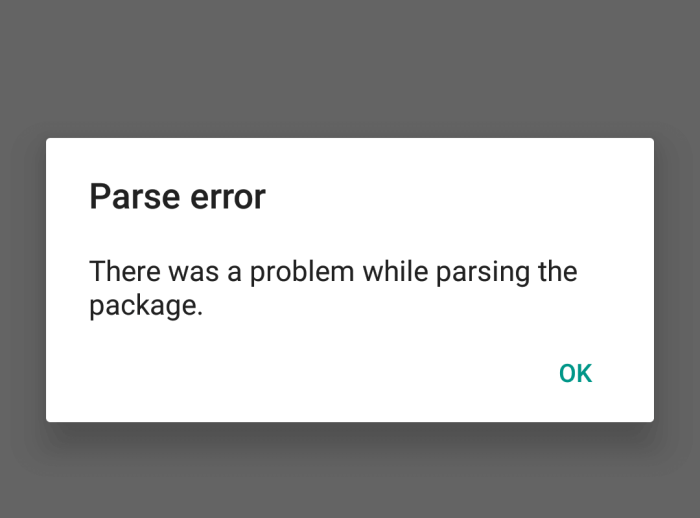
Coping with the “Drawback Parsing Bundle” error on Android can really feel like navigating a maze. Don’t be concerned, we’ll gentle the trail with a step-by-step information to get you again on observe. This part equips you with the instruments and information to beat this irritating hurdle and set up these apps you are keen to make use of.
Checking APK File Integrity
Earlier than you even take into consideration putting in, make sure the APK file itself is sound. A corrupted file is a surefire technique to encounter the “Drawback Parsing Bundle” error. Consider it like making an attempt to bake a cake with spoiled components; it isn’t going to finish effectively. Right here’s how you can carry out a fast integrity verify:
Step one is to verify if the file was downloaded correctly. A corrupted obtain can simply trigger the parsing error. A easy technique to verify is to redownload the APK from a dependable supply. One other verify could be made by evaluating the file dimension with the unique supply.
Think about the state of affairs of downloading a well-liked sport APK. If the file dimension you downloaded is considerably smaller than the one marketed on the official web site or a trusted supply, it is extremely possible that the obtain was interrupted or corrupted. On this case, downloading the APK once more from a dependable supply is your first step to decision. Moreover, in case you’re getting the APK from an unofficial supply, contemplate the opportunity of malware or a tampered file, which may additionally set off the parsing error.
One other strategy includes utilizing checksums. APK recordsdata, like different digital recordsdata, typically include checksums (like MD5 or SHA-256). These are distinctive “fingerprints” of the file. By evaluating the checksum of your downloaded APK with the checksum supplied by the APK’s supply, you possibly can confirm its integrity. If the checksums do not match, the file is corrupted.
This methodology is like evaluating a product’s serial quantity with the producer’s database to make sure it is genuine.
Right here’s how you can use a web-based checksum calculator (many can be found):
- Get hold of the Checksum: Discover the checksum (MD5, SHA-1, or SHA-256) for the unique APK file from the supply you downloaded it from.
- Add or Enter the APK: Use a web-based checksum calculator (search “on-line checksum calculator”). Add your APK file or present the file path.
- Evaluate the Outcomes: The calculator will generate a checksum to your file. Evaluate this checksum to the one you obtained from the APK’s supply.
- Verification: If the checksums match, the APK file is probably going intact. In the event that they differ, the file is corrupted.
Verifying Android Model Compatibility
Not all apps are created equal, and never all Android variations are both. Earlier than you attempt to set up, be sure the app is suitable along with your system’s Android model. It’s like making an attempt to suit a sq. peg right into a spherical gap – it simply will not work.
Android app builders specify a minimal Android model required for his or her apps to perform. This info is usually discovered on the app’s itemizing within the Google Play Retailer (if it is accessible there) or on the app’s official web site. If the app will not be accessible on the Google Play Retailer, this info may be within the APK’s documentation or on the web site the place you downloaded the APK.
You’ll find your system’s Android model within the Settings app. The trail to this info might differ barely relying in your system producer and Android model, however typically, yow will discover it underneath “About telephone” or “About system.” Search for the “Android model” or “Software program info” part.
For instance, if an app requires Android 7.0 (Nougat) or larger, and your system is working Android 6.0 (Marshmallow), you’ll encounter the “Drawback Parsing Bundle” error. Upgrading your system’s Android model (if attainable) is commonly the answer, however this is not all the time possible as older units won’t obtain updates.
Alternatively, contemplate looking for an older model of the app that may be suitable along with your Android model. Web sites that archive older APK variations could be useful, however be extraordinarily cautious in regards to the supply and all the time verify the APK file’s integrity earlier than putting in.
Clearing Bundle Installer Cache and Information
The Bundle Installer app is the gatekeeper of app installations. Typically, its cache or saved information could cause points. Clearing this information is like giving the gatekeeper a recent begin.
Clearing the cache and information of the Bundle Installer can resolve short-term glitches that may be stopping the set up of APK recordsdata. This course of does not delete any of your put in apps; it solely resets the Bundle Installer app itself.
Right here’s how you can do it:
- Open Settings: Go to your system’s Settings app.
- Navigate to Apps: Faucet on “Apps” or “Apps & notifications.” The precise wording might differ relying in your system.
- Discover Bundle Installer: Scroll by means of the record of apps and find “Bundle Installer.” You may have to faucet “See all apps” or the same possibility to seek out it.
- Storage: Faucet on “Storage” or “Storage & cache.”
- Clear Cache: Faucet on “Clear cache.”
- Clear Information: Faucet on “Clear information” or “Clear storage.” Affirm by tapping “OK” or “Delete” when prompted.
- Restart: Restart your system.
Clearing the cache and information will reset the Bundle Installer to its default state. This will typically resolve points associated to corrupted set up recordsdata or conflicts with earlier set up makes an attempt.
Enabling “Unknown Sources” or “Set up from Unknown Apps”
Android’s safety settings are designed to guard you from probably dangerous apps. To put in apps from exterior the Google Play Retailer (sideloading), you want to grant your system permission. That is typically referred to as enabling “Unknown sources” or “Set up from unknown apps.”
This setting is crucial for putting in apps from sources apart from the Google Play Retailer. It’s a safety characteristic that stops your system from mechanically putting in apps that would probably hurt your system or steal your information.
The situation of this setting has modified over Android variations. Right here’s how you can discover it:
- Android 8.0 (Oreo) and later: The setting is now app-specific. It’s essential to grant permission to put in apps from every particular person app (e.g., your internet browser or file supervisor) that you simply use to obtain APK recordsdata.
- Go to Settings > Apps & notifications > Particular app entry > Set up unknown apps.
- Choose the app (e.g., Chrome, Information by Google) that you simply use to obtain APKs.
- Toggle the “Permit from this supply” swap to the on place.
- Android 7.0 (Nougat) and earlier:
- Go to Settings > Safety.
- Allow the “Unknown sources” possibility.
Enabling this setting is essential earlier than making an attempt to put in an APK file from a supply apart from the Google Play Retailer. Bear in mind to be cautious in regards to the sources from which you obtain APK recordsdata and solely allow this setting for trusted sources.
Sideloading APK Information Utilizing ADB (Android Debug Bridge)
For the tech-savvy, utilizing ADB (Android Debug Bridge) provides a extra sturdy technique to set up APK recordsdata. ADB is a command-line software that means that you can talk along with your Android system. It is like having a direct line to your telephone’s internal workings.
ADB gives a robust technique to set up APK recordsdata instantly out of your laptop to your Android system. This methodology could be helpful if you end up unable to put in an app utilizing the usual strategies, or when you want to troubleshoot set up points extra deeply.
Right here’s how you can sideload an APK file utilizing ADB:
- Set up ADB: It’s essential to set up the Android SDK Platform Instruments in your laptop. These instruments embody ADB. You’ll be able to obtain them from the official Android Builders web site.
- Allow USB Debugging in your system:
- Go to Settings > About telephone.
- Faucet on “Construct quantity” seven instances to allow Developer choices.
- Return to Settings and faucet on “Developer choices.”
- Allow “USB debugging.”
- Join your system to your laptop: Use a USB cable to attach your Android system to your laptop.
- Open a Command Immediate or Terminal: Open a command immediate (Home windows) or terminal (macOS/Linux) in your laptop.
- Navigate to the ADB listing: Use the `cd` command to navigate to the listing the place you put in the ADB instruments.
- Set up the APK: Use the next command to put in the APK:
adb set up <path_to_your_apk_file>
Substitute
<path_to_your_apk_file>with the precise path to your APK file. For instance, in case your APK file is positioned within the “Downloads” folder in your desktop, the command may appear like this:adb set up C:UsersYourUsernameDownloadsyour_app.apk(Home windows) oradb set up /Customers/YourUsername/Downloads/your_app.apk(macOS/Linux). - Examine the Output: The command immediate or terminal will show the set up standing. If the set up is profitable, it’s best to see a “Success” message. If there’s an error, the output will present details about the difficulty.
Utilizing ADB provides a extra managed and probably extra dependable methodology for putting in APK recordsdata. If you happen to encounter points, ADB can present detailed error messages that make it easier to diagnose the issue.
Bundle Construction and Manifest Points
Let’s dive into the nitty-gritty of Android package deal construction, significantly specializing in the position of the manifest file. That is the place the magic occurs, or generally, the place issues go horribly unsuitable, resulting in these dreaded “Drawback Parsing Bundle” errors. Understanding the manifest is essential; it is the blueprint that tells the Android system every part it must learn about your app.
The Position of AndroidManifest.xml
The `AndroidManifest.xml` file is the central nervous system of an Android utility. Consider it as the applying’s official introduction to the Android working system. It is a structured XML file that gives important details about the applying, together with its title, package deal title, parts (actions, companies, broadcast receivers, content material suppliers), permissions required, and {hardware} and software program options it makes use of. And not using a correctly configured `AndroidManifest.xml`, your app will not even get off the bottom.
It’s completely important for the Android system to accurately perceive and run your utility.
Significance of Bundle Identify
The package deal title, declared inside the `AndroidManifest.xml` file, is the distinctive identifier to your utility. It’s like a digital fingerprint. This package deal title is globally distinctive throughout the whole Android ecosystem. It is used for a number of essential capabilities: figuring out your app on the system, permitting the system to replace your app, and enabling inter-app communication. Selecting the best package deal title is a essential first step.
It’s the basic identifier of your utility, and it should be globally distinctive throughout all Android units. This uniqueness is enforced by the Google Play Retailer and is crucial for updates and installations.
Frequent Manifest Errors
A single misplaced character, a forgotten permission, or an incorrect intent filter can ship your manifest file spiraling into error-ville. These manifest errors are frequent culprits behind “Drawback Parsing Bundle” errors. They forestall the Android system from accurately deciphering the applying’s construction and parts. Let’s take a look at some frequent pitfalls and how you can keep away from them.
Manifest Entries and Potential Pitfalls
Under are frequent manifest entries and their potential points, offered in a format that is each clear and concise, together with explanations and how you can repair them. Think about this your manifest survival information.
-
Bundle Identify: This needs to be a singular identifier, typically following a reverse area title conference (e.g., `com.instance.myapp`).
- Pitfall: Utilizing a package deal title that is already in use, comprises invalid characters, or will not be correctly formatted.
- Instance: A package deal title like “my.app” or “com.instance.MyApp” (be aware the capitalization) will trigger points.
- Permissions: Declaring the permissions your app wants (e.g., `android.permission.INTERNET`, `android.permission.CAMERA`).
- Pitfall: Requesting permissions that aren’t truly utilized by your utility or misspelling permission names.
- Instance: Requesting `android.permission.ACCESS_FINE_LOCATION` with out utilizing location companies. Or, `android.permission.CAMERAa` will trigger a construct error.
- Actions, Providers, Broadcast Receivers, Content material Suppliers: Declaring the applying parts.
- Pitfall: Incorrectly declaring the part, lacking obligatory attributes, or typos within the part title.
- Instance: Forgetting to declare an exercise within the manifest or misusing intent filters.
- Intent Filters: Defining how your app responds to system occasions.
- Pitfall: Incorrectly outlined intent filters, akin to lacking or incorrect actions or classes.
- Instance: An intent filter for `android.intent.motion.VIEW` with out specifying a `information` factor for the information being considered.
Frequent Manifest Errors, Causes, and Options
This is a helpful desk to information you thru among the commonest manifest errors:
| Frequent Manifest Error | Associated Causes | Prompt Fixes |
|---|---|---|
Bundle title doesn't match the file construction |
|
|
Permission denied or Requires permission... |
|
|
Exercise not declared in manifest |
|
|
Incorrect syntax in XML or Sudden factor discovered |
|
|
Utility Label not set |
|
|
Goal SDK model too low or API degree points |
|
|
APK Signing and Verification: Drawback Parsing Bundle Android
The safety and integrity of Android purposes hinge on a vital course of often known as APK signing and verification. Consider it as a digital seal of approval, guaranteeing that the applying comes from a trusted supply and hasn’t been tampered with because it was created. This course of is prime for the Android ecosystem, permitting the working system to confirm the authenticity and integrity of put in purposes.
Let’s delve into the mechanics of this important course of.
APK Signing Course of
Signing an APK is akin to digitally notarizing your utility. It includes utilizing cryptographic keys to create a signature that’s embedded inside the APK file. This signature acts as proof that the applying is real and has not been altered.The method unfolds in a number of key steps:
- Key Era: The developer begins by producing a cryptographic key pair, consisting of a non-public key (stored secret) and a public key (shared). The non-public secret is used to signal the APK, whereas the general public secret is embedded within the utility’s manifest.
- Keystore Creation: The important thing pair, together with different figuring out info just like the developer’s title and group, is saved in a keystore file. This file acts as a safe container for the developer’s digital certificates.
- APK Signing: The signing course of makes use of the non-public key to generate a digital signature for the APK file. This signature is predicated on the contents of the APK and is used to confirm the integrity of the applying.
- Manifest Modification: The applying’s manifest file, `AndroidManifest.xml`, is up to date to incorporate the general public key certificates. This permits the Android system to confirm the signature in opposition to the general public key.
Debug and Launch Signing Variations
There are two major signing configurations: debug and launch. The selection impacts how the applying is constructed and distributed.The variations are:
- Debug Signing: Used primarily throughout improvement and testing. Android Studio mechanically generates a debug keystore, simplifying the signing course of. Debug builds are signed with a pre-generated debug key.
- Launch Signing: Employed for purposes destined for distribution (e.g., Google Play Retailer). Builders should create their very own keystore and personal key. Launch builds are signed with this non-public key, guaranteeing the applying’s authenticity and safety.
Using a debug keystore streamlines the event course of. Nonetheless, launch signing is a non-negotiable step earlier than publishing an utility, because it ensures the applying’s integrity and verifies the developer’s identification.
Keystore File Significance
The keystore file is a essential part within the Android utility signing course of. It holds the developer’s non-public key, which is used to signal the APK.Its significance stems from:
- Safety: The keystore safeguards the non-public key, stopping unauthorized entry and guaranteeing the integrity of the applying.
- Authenticity: The keystore permits the Android system to confirm the applying’s authenticity by matching the signature with the general public key saved within the manifest.
- Updates: The keystore is essential for updating an utility. Solely an utility signed with the identical key can replace a beforehand put in utility.
Defending the keystore file is paramount. If the non-public secret is compromised, attackers may signal malicious updates, probably compromising consumer units.
Verifying APK Signature with `jarsigner` or `apksigner`
Verifying an APK signature is a vital step to verify its integrity and authenticity. Android gives instruments like `jarsigner` (a part of the JDK) and `apksigner` (Android SDK) to carry out this verification. These instruments analyze the APK’s signature and evaluate it in opposition to the anticipated values.The method includes:
- Utilizing `jarsigner`: This software, historically used for signing JAR recordsdata, can even confirm APK signatures. The command usually includes specifying the APK file and the keystore.
- Utilizing `apksigner`: This can be a devoted software particularly designed for Android APK signing and verification. It gives extra options and is usually really helpful. The command consists of specifying the APK file.
- Output Interpretation: The output from these instruments signifies whether or not the signature is legitimate or not. A profitable verification confirms that the APK has not been tampered with.
Instance of Checking APK Signature and Anticipated Output
This is an instance of how you can verify the APK signature utilizing `apksigner`, together with the anticipated output:First, use the next command:“`bashapksigner confirm myapp.apk“`The output, if the signature is legitimate, ought to resemble this:
Verified utilizing v1 scheme (JAR signing): true
Verified utilizing v2 scheme (APK Signature Scheme v2): true
Verified utilizing v3 scheme (APK Signature Scheme v3): true
Verified utilizing v4 scheme (APK Signature Scheme v4): false
Legitimate APK
This output signifies that the APK’s signature has been efficiently verified utilizing the v1, v2, and v3 signing schemes. The `Legitimate APK` message confirms that the applying is signed accurately and could be put in on a suitable Android system. The “false” on v4 signifies that it isn’t utilizing the newest scheme.
System Compatibility and {Hardware} Concerns
Navigating the Android ecosystem can generally really feel like making an attempt to herd cats – a mess of units, every with its personal quirks and capabilities. On the subject of “Drawback Parsing Bundle” errors, system compatibility is a significant offender. It is like constructing a home; if the muse is not proper for the soil, the entire thing crumbles. This part dives into the intricate relationship between your app and the huge array of Android units on the market, exploring the architectural variations and how you can make your app play good with everybody.
Influence of System Compatibility on Parsing Bundle Points
The “Drawback Parsing Bundle” error continuously arises when an utility is incompatible with a consumer’s system. This incompatibility can stem from varied components, together with the Android model, display screen dimension, {hardware} options, and most significantly, the system’s structure. Think about making an attempt to suit a sq. peg right into a spherical gap – the identical precept applies right here. An APK (Android Bundle Equipment) designed for one sort of system won’t be understood by one other, resulting in this irritating error.
As an illustration, an app constructed with a minimal SDK model larger than the system’s Android model merely will not set up, leading to a parsing failure. Moreover, apps requiring particular {hardware} options (like a gyroscope or NFC) will fail to put in on units missing these parts.
Android {Hardware} Architectures and Their Results
Android units do not all converse the identical language. They make the most of totally different {hardware} architectures, the most typical being ARM and x86. Consider it because the engine underneath the hood of a automobile.* ARM (Superior RISC Machines): This structure is the dominant pressure within the Android world, powering the overwhelming majority of smartphones and tablets. ARM processors are identified for his or her energy effectivity, making them supreme for cell units.
They arrive in varied flavors (ARMv7, ARMv8, and many others.), every with totally different capabilities.* x86: Primarily related to Intel and AMD processors, x86 is much less prevalent within the cell area however could be present in some Android tablets and units like Chromebooks that may run Android apps.The APK recordsdata are constructed particularly for sure architectures. An APK constructed for ARM units won’t run on an x86 system except it comprises the suitable architecture-specific binaries.
This can be a frequent reason for “Drawback Parsing Bundle” errors.
Figuring out Supported Architectures of an APK File
Understanding the supported architectures of an APK is essential for diagnosing compatibility points. Happily, Android gives a simple technique to peek inside an APK and see what it is manufactured from. You should use the `apktool` command-line software or the Android Debug Bridge (ADB) to extract the APK and study its contents. The important thing lies within the `lib` listing inside the APK.* Contained in the `lib` listing, you may discover subdirectories named after the supported architectures, akin to `armeabi-v7a`, `arm64-v8a`, `x86`, and `x86_64`.
- The presence of a selected structure listing signifies that the APK consists of native libraries (written in C/C++) compiled for that structure. If the system’s structure is not supported, it’ll end in a parsing error.
- If no `lib` listing is current, the APK possible comprises solely Java code and will theoretically run on any Android system, assuming it meets different compatibility necessities.
Addressing Compatibility Points in App Improvement, Drawback parsing package deal android
Creating apps for a various vary of Android units requires cautious consideration of compatibility. This is a breakdown of methods to handle potential points:* Focusing on A number of Architectures: The commonest strategy is to construct an APK that helps a number of architectures. This implies together with native libraries for ARM (often `armeabi-v7a` and `arm64-v8a`) and, if wanted, x86. This will increase the APK dimension however ensures broader compatibility.* Utilizing the Android NDK (Native Improvement Equipment): The NDK permits builders to put in writing components of their app in C/C++ and compile them into native libraries.
When utilizing the NDK, you need to specify which architectures your libraries ought to assist.* Utilizing Android App Bundles: App Bundles are Google’s really helpful publishing format. They permit you to construct a single APK that comprises all of your code and sources, and Google Play then generates optimized APKs for every consumer’s system, together with solely the required native libraries.* Minimal and Goal SDK Variations: Setting the `minSdkVersion` and `targetSdkVersion` in your app’s `construct.gradle` file is essential.
`minSdkVersion` defines the bottom Android model your app helps. `targetSdkVersion` is the model you’ve got examined your app in opposition to.* {Hardware} Characteristic Declarations: Declare any {hardware} options your app requires within the `AndroidManifest.xml` file. This prevents the app from being put in on units missing these options. For instance, in case your app requires a digital camera, embody ` `.* Testing on Actual Gadgets: Emulators are useful, however nothing beats testing on quite a lot of actual units with totally different architectures and Android variations.This is an HTML desk summarizing the important thing features of structure compatibility:
| Structure | Appropriate Gadgets | Finest Practices | Frequent Points |
|---|---|---|---|
| ARM (armeabi-v7a, arm64-v8a) | Most Android smartphones and tablets |
|
|
| x86 | Some Android tablets, Chromebooks, and emulators |
|
|
| x86_64 | 64-bit x86 units |
|
|
| No Native Libraries (Pure Java) | Most Android units |
|
|
Instruments and Strategies for Diagnosing the Drawback
Coping with the “Drawback Parsing Bundle” error in Android can really feel like navigating a maze. Happily, a collection of highly effective instruments and methods exists to light up the trail to an answer. These instruments vary from the command-line to stylish IDE options, offering builders with the sources wanted to pinpoint the basis reason for the parsing failure. This part dives into these diagnostic devices, providing sensible steerage to effectively deal with this frequent Android improvement hurdle.
Figuring out Instruments for Analysis
A wide range of instruments can be found for diagnosing the “Drawback Parsing Bundle” error, every providing distinctive insights into the difficulty. These instruments assist in uncovering the trigger, whether or not it is associated to the APK file itself, the system, or the Android system.
- Logcat: This command-line software gives real-time system and utility logs, essential for figuring out error messages and stack traces associated to package deal parsing failures.
- Android Studio’s Constructed-in Debugging Instruments: Android Studio provides a complete suite of debugging instruments, together with the debugger, profiler, and format inspector, which could be invaluable in understanding the applying’s conduct and figuring out potential points.
- APK Analyzer: This software, additionally built-in into Android Studio, permits builders to examine the contents of an APK file, offering detailed details about its construction, sources, and dependencies.
- adb (Android Debug Bridge): ADB is a flexible command-line software that facilitates communication with an Android system, enabling actions akin to putting in and uninstalling apps, retrieving system logs, and executing shell instructions.
- System-Particular Debugging Instruments: Some Android system producers present their very own debugging instruments or utilities that may supply further diagnostic info.
Utilizing Logcat to Determine Parsing Errors
Logcat is a necessary software for diagnosing the “Drawback Parsing Bundle” error, offering a window into the internal workings of the Android system. It captures system and utility logs, together with error messages, warnings, and informational messages. This info is essential for figuring out the reason for package deal parsing failures.The method of utilizing Logcat to determine errors associated to package deal parsing includes the next steps:
- Join your system: Guarantee your Android system is linked to your laptop through USB and that USB debugging is enabled within the system’s developer choices.
- Open Logcat: Open Logcat both by means of Android Studio’s “Logcat” view or through the use of the command-line software. If utilizing the command line, you possibly can usually entry it by typing
adb logcatin your terminal or command immediate. - Filter the logs: To slender down the search, filter the logs. You’ll be able to filter by log degree (e.g., error, warning, information), tag (e.g., “PackageManager”, “PackageParser”), or (e.g., “parse”, “error”).
- Reproduce the error: Try to put in the APK on the system. Observe the Logcat output in real-time.
- Analyze the output: Search for error messages, warnings, and stack traces that seem throughout the set up course of. These messages typically present clues in regards to the particular downside, akin to lacking permissions, incompatible architectures, or corrupted recordsdata.
Instance of a typical Logcat error message associated to package deal parsing:
E AndroidRuntime: FATAL EXCEPTION: most important
E AndroidRuntime: Course of: com.instance.myapp, PID: 12345
E AndroidRuntime: java.lang.RuntimeException: Bundle com.instance.myapp has corrupt manifest
E AndroidRuntime:     at android.app.ActivityThread.handleBindApplication(ActivityThread.java:4982)
E AndroidRuntime:     at android.app.ActivityThread.entry$1600(ActivityThread.java:185)
E AndroidRuntime:     at android.app.ActivityThread$H.handleMessage(ActivityThread.java:1699)
E AndroidRuntime:     at android.os.Handler.dispatchMessage(Handler.java:102)
E AndroidRuntime:     at android.os.Looper.loop(Looper.java:154)
E AndroidRuntime:     at android.app.ActivityThread.most important(ActivityThread.java:6119)
E AndroidRuntime:     at java.lang.replicate.Technique.invoke(Native Technique)
E AndroidRuntime:     at com.android.inside.os.ZygoteInit$MethodAndArgsCaller.run(ZygoteInit.java:886)
E AndroidRuntime:     at com.android.inside.os.ZygoteInit.most important(ZygoteInit.java:776)
On this instance, the Logcat output clearly signifies a “corrupt manifest” as the reason for the parsing failure.
Utilizing Android Studio’s Constructed-in Debugging Instruments
Android Studio’s built-in debugging instruments present a complete surroundings for figuring out and resolving points, together with these associated to package deal parsing. The built-in debugger, profiler, and format inspector supply highly effective capabilities for analyzing utility conduct and pinpointing issues.
The first debugging instruments inside Android Studio embody:
- Debugger: The debugger means that you can step by means of your code line by line, examine variables, and set breakpoints to pause execution at particular factors. That is helpful for figuring out points inside your utility’s initialization or manifest parsing logic.
- Profiler: The profiler helps you analyze your utility’s efficiency, together with CPU utilization, reminiscence allocation, and community exercise. This may be useful for figuring out resource-intensive operations which may contribute to parsing errors.
- Format Inspector: The format inspector means that you can study the visible hierarchy of your utility’s UI, together with views, attributes, and properties. This may be helpful for figuring out layout-related points which may have an effect on package deal parsing.
- Construct Variants: Android Studio’s construct variants characteristic means that you can create totally different builds of your utility with various configurations, akin to totally different useful resource recordsdata or manifest settings. This may be useful for testing totally different configurations and figuring out compatibility points.
To make use of the debugger, you usually:
- Set breakpoints: Place breakpoints in your code the place you think points may be occurring, akin to within the
onCreate()methodology of yourUtilityclass or within the code that handles manifest parsing. - Begin the debugger: Run your utility in debug mode by deciding on “Debug” from the “Run” menu or by clicking the debug icon.
- Step by means of the code: Use the debugger controls (e.g., step over, step into, step out) to execute your code line by line and observe the values of variables.
- Examine variables: Look at the values of variables to determine potential points.
Utilizing APK Analyzer to Examine APK Information
APK Analyzer, built-in into Android Studio, gives an in depth view of an APK file’s contents. This software is invaluable for understanding the construction, sources, and dependencies of an APK, making it a key factor in diagnosing “Drawback Parsing Bundle” errors.
To make use of APK Analyzer:
- Construct your APK: Generate your APK file. This is usually a debug or launch construct.
- Open the APK in Android Studio: In Android Studio, choose “Construct” -> “Analyze APK…” or drag and drop the APK file into the Android Studio window.
- Discover the APK construction: The APK Analyzer will show the APK’s contents in a tree view.
- Examine particular components: Click on on totally different components within the tree view to view particulars.
Info Supplied by APK Analyzer: Descriptive Instance
APK Analyzer gives a wealth of details about an APK file, which could be essential for diagnosing “Drawback Parsing Bundle” errors. This info consists of:
- Manifest File Inspection: The APK Analyzer means that you can view the
AndroidManifest.xmlfile, highlighting potential points akin to incorrect permissions, lacking or malformed components, and compatibility points. - Useful resource Evaluation: You’ll be able to examine the sources listing, together with pictures, layouts, and different belongings, to determine potential issues. This consists of checking for lacking sources, useful resource conflicts, and useful resource versioning points.
- Dex File Inspection: APK Analyzer means that you can view the contents of the DEX recordsdata, which comprise the compiled bytecode of your utility. This may be useful for figuring out points associated to code obfuscation, incorrect dependencies, or class conflicts.
- File Dimension Breakdown: The analyzer gives a breakdown of the APK’s dimension, exhibiting the contribution of every part (code, sources, belongings). This may also help determine areas the place you possibly can optimize the APK dimension, which might generally be a consider parsing points on units with restricted storage.
- Dependency Evaluation: APK Analyzer reveals the dependencies of the applying, together with libraries and different exterior parts. This may also help determine dependency conflicts or versioning issues.
As an illustration, contemplate an instance the place the APK Analyzer reveals a difficulty within the manifest file. As an example the manifest declares a permission that isn’t correctly outlined within the system. The APK Analyzer will spotlight this in crimson, and if you click on on the permission declaration, it’ll present an error message, akin to “Permission not discovered.” This lets you instantly determine the difficulty and proper it by including the required permission definition in your AndroidManifest.xml file.
One other instance includes the inspection of useful resource recordsdata. Suppose the APK Analyzer exhibits {that a} sure picture file is lacking or corrupted. When making an attempt to put in the APK, the system may encounter a “Drawback Parsing Bundle” error as a result of the system can’t find or correctly course of the lacking useful resource. By inspecting the APK with the analyzer, you possibly can shortly determine the lacking file, change it, and resolve the parsing error.
Safety and Permissions
Permissions in Android are like a safety guard on the door of your app. They management what your app can entry on a consumer’s system, guaranteeing privateness and safety. Getting these permissions proper is essential, and missteps can result in the dreaded “Drawback Parsing Bundle” error, amongst different complications. Let’s delve into how permissions work and how you can keep away from these points.
Permission-Associated Points and Parsing Errors
Permissions are basically linked to parsing errors as a result of they’re declared within the AndroidManifest.xml file, the blueprint to your app. If these declarations are incorrect—lacking, misspelled, or conflicting—the system cannot perceive your app’s wants, and the parsing course of fails. The Android system depends on this manifest to know what sources your app requires, and if it might’t accurately interpret the permissions, it will not set up.
Significance of Right Permission Declarations
Declaring permissions precisely within the manifest is paramount for a easy set up and operation of your app. It is the app’s manner of telling the working system, “Hey, I have to entry the digital camera,” or “I have to learn the consumer’s contacts.” With out these declarations, your app shall be sandboxed, severely limiting its performance. Right declarations are additionally important for consumer belief; they see what your app
-claims* it wants entry to.
Frequent Permission-Associated Errors and Options
Errors typically come up from typos, incorrect syntax, or lacking declarations.
Listed below are some frequent examples and how you can repair them:
- Lacking Permission Declaration: Think about you are making an attempt to make use of the digital camera with out declaring the
android.permission.CAMERApermission in your manifest. The app will possible crash or just not perform as anticipated, and through set up, you may encounter a parsing error.Answer: Add the permission declaration inside the
<manifest>tag in your AndroidManifest.xml:<uses-permission android:title="android.permission.CAMERA" /> - Incorrect Permission Syntax: A easy typo, like writing
android.permission.CAMERRA(with an additional “r”), could cause a parsing error as a result of the system will not acknowledge the misspelled permission.Answer: Double-check your spelling and syntax in opposition to the official Android documentation.
- Conflicting Permissions: If you happen to’re utilizing a library that requires a sure permission, and your app declares a conflicting model or a associated permission that is dealt with in another way, it might result in conflicts.
Answer: Overview the permissions requested by all libraries in your challenge and guarantee there are not any conflicts.
You might have to replace the library or modify your manifest to accommodate the conflicting necessities, rigorously contemplating the influence in your app’s performance.
Influence of Requesting Extreme Permissions
Requesting too many permissions, particularly these unrelated to your app’s core performance, is usually a main crimson flag. It erodes consumer belief and may result in decrease app set up charges. Customers are cautious of apps that ask for extra entry than obligatory. Additionally, extreme permissions could make your app a goal for malware, as extra entry factors enhance the potential assault floor.
It is like leaving all of the doorways and home windows of your own home unlocked; it makes it simpler for undesirable guests to enter.
Frequent Permissions and Their Potential Influence
This is a breakdown of some frequent permissions and the potential influence of their misuse:
android.permission.CAMERA: Permits entry to the system’s digital camera.- Potential Influence: Might be used to secretly document video or take pictures.
android.permission.READ_CONTACTS: Permits studying the consumer’s contact record.- Potential Influence: Might be used to steal contact info for spamming or phishing.
android.permission.ACCESS_FINE_LOCATION: Permits entry to specific location information (GPS).- Potential Influence: Might be used to trace the consumer’s location and actions.
android.permission.READ_SMS: Permits studying SMS messages.- Potential Influence: Might be used to intercept verification codes, entry delicate info, or unfold malware by means of SMS.
android.permission.RECORD_AUDIO: Permits recording audio from the microphone.- Potential Influence: Might be used to secretly document conversations.
android.permission.CALL_PHONE: Permits the app to make telephone calls.- Potential Influence: Might be used to make premium-rate calls with out the consumer’s information, leading to surprising costs.
android.permission.READ_EXTERNAL_STORAGE: Permits studying recordsdata from exterior storage (just like the SD card).- Potential Influence: Might be used to entry and steal private recordsdata, akin to pictures and paperwork.
android.permission.WRITE_EXTERNAL_STORAGE: Permits writing recordsdata to exterior storage.- Potential Influence: Might be used to change or delete consumer recordsdata, or to put in malicious software program.
android.permission.SEND_SMS: Permits sending SMS messages.- Potential Influence: Might be used to ship spam or phishing messages.
Replace and Versioning Conflicts
It is a frequent tech headache: you obtain a brand new app or replace an current one, and BAM! “Drawback parsing package deal.” Usually, this digital hiccup stems from a conflict between the brand new and the outdated, a battle of variations that leaves your Android system scratching its head. Let’s delve into how these conflicts come up and, extra importantly, how you can forestall them from turning your telephone right into a brick.
The Position of VersionCode and VersionName
The Android manifest file is just like the app’s ID card. It comprises essential details about the applying, and two of probably the most essential items of data are the `versionCode` and `versionName` attributes.
* `versionCode`: That is an integer representing the model of the applying. It is used internally by the system for comparisons. Consider it because the app’s distinctive serial quantity. Every replace ought to increment the `versionCode`.
– `versionName`: This can be a user-friendly string that represents the model.
It is what you see within the app’s settings or on the Google Play Retailer. Frequent examples embody “1.0,” “1.2.3,” or “2.0 Beta.”
The `versionCode` should all the time enhance with every new launch. The Android system makes use of this to find out if an replace is newer than the at present put in model. The `versionName` could be something you select, however it’s essential for customers to know what model they’ve put in.
The `versionCode` is the system’s secret handshake; `versionName` is the general public greeting.
Managing Updates and Stopping Versioning-Associated Errors
Navigating the world of app updates requires a strategic strategy to sidestep versioning pitfalls. This is a breakdown of finest practices:
* Increment `versionCode` Persistently: At all times enhance the `versionCode` within the manifest file for every new launch, even when it is only a minor bug repair.
– Semantic Versioning: Undertake a constant versioning scheme, akin to Semantic Versioning (SemVer), which makes use of a MAJOR.MINOR.PATCH format (e.g., 1.2.3). This makes it simpler to know the scope of adjustments in every replace.
– Testing, Testing, Testing: Totally take a look at updates on varied units and Android variations earlier than releasing them to the general public. Beta testing packages could be invaluable.
– Backward Compatibility: Try to take care of backward compatibility as a lot as attainable. Keep away from making breaking adjustments that would trigger older variations of the app to malfunction after an replace.
– Clear Communication: Talk model adjustments and any potential compatibility points to your customers.
Present clear launch notes explaining what’s new and what’s modified.
Frequent Versioning Errors and Resolutions
Versioning errors could be irritating, however they’re typically simply mounted. This is a desk summarizing frequent errors, their causes, and how you can resolve them:
| Versioning Error | Causes | Options |
|---|---|---|
| “Drawback parsing package deal” after replace. |
|
|
| “Utility couldn’t be put in” or “App not put in”. |
|
|
| Downgrade not allowed (e.g., older model put in). |
|
|
| Set up fails on particular units. |
|
|
